
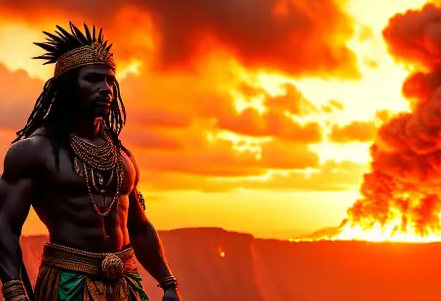
Aganjú is the Yorùbá Òrìṣà of volcanoes, wild land, and strong earth. His name means “voice of the desert.” It shows lava’s rumble and desert power.
Related to Saint Christopher in Santería and Candomblé, Aganjú once ruled Shaki, then wandered deserts after fights. He is Shàngó’s brother in Yorùbá tales. Some diaspora stories call him Shàngó’s father.
However, Santería combines both ideas with burgundy colors and the number nine. Aganjú rules volcanoes, deserts, and mountains. His symbols include a mace, a shovel, keys, and elephants, while his colors are burgundy, brown, and gold, in nines.
READ ALSO: All You Need To Know About Otokoto Ritual Killings
Who Is Aganju?
Àgànjú is an Òrìṣà of fire, wild land, and strong force that holds the raw power of the earth. His name comes from Yorùbá words that mean “voice of the desert” or “power from another world.”
These meanings call to mind the sound of hot lava and the dry breath of empty land. In Santéría and Candomblé, people connect him with Saint Christopher, a guide who helps travelers carry heavy loads across rough paths.
Àgànjú rises from old Yorùbá stories. He comes from the meeting of earth and fire. In early tales, he ruled the hot land of Shákí as a brave warrior. He kept order with firm action. When he faced rivals, he left his home and walked through wide deserts.
Elders kept his story alive through patakí and Ifá teachings across West Africa and the diaspora. His power touches many places.
He rules volcanoes and flowing lava. He brings change through fire and new beginnings after destruction. He lives in wild spaces, mountains, and dry plains. These places test the body and the spirit.
Àgànjú also has the strength of iron-rich soil and red earth. People call him during hard times, such as loss of work, sickness, or moving far from home.
They also call him in moments of natural danger. His energy helps turn blocks into openings in Yorùbá thought. In Cuban Santéría (Lukumí), people call him Agayú or Aggayú. Aggayú-Solá points to his relationship with the sun.
In Brazilian Candomblé, he is Àgànjú Soláyì. These names changed during the time of forced migration, but his core signs stayed the same, such as the number nine.
In many stories, he is close to Ṣàngó, Yemōjá, and Ọya. He moves as a guide, a protector, and a carrier of heavy burdens.
Once seen as a force that challenged others, he later became the one who helps keep the balance. With Ọbàtálá, he shows how fire can break the ground open and make space for new life.
Is Aganju Shango’s Father Or Brother?
In Yorùbá religion and its diaspora paths like Santería and Candomblé, Aganjú is known as Ṣàngó’s brother. Some patakí stories call him Ṣàngó’s father.
These changes happen because sacred stories move through many regions, many Ifá lines, and the long history of the Atlantic crossing.
In old Yorùbá cosmology in Nigeria, Aganjú appears as Ṣàngó’s brother. He is the warrior king of the hot Ṣákì land. His strict rule often clashes with Ṣàngó’s rising power of thunder. Their fight ends with Aganjú leaving for the wide deserts.
His voice sounds like volcano fire rolling through canyons. Òyá carries these sounds in her storms. In Santería’s Lukumí tradition, many people keep the idea of brotherhood. Some groups also accept the father story.
In those lines, Aganjú is the elder who tests Ṣàngó or gives heat that forms his lightning. They share the number 9, red colors, and heavy mace tools.
In Brazilian Candomblé, people see Aganjú as father. Aggayú-Solá gives birth to Ṣàngó through fire and yellow-brown earth.
He gives him desert strength and sun power. In this story, Ṣàngó grows into fierce change, while Aganjú keeps the force of wild places.
One well-known brother tale describes Aganjú defending Ṣákì when Ṣàngó tries to enter. In the end, Aganjú goes wandering, and they later work together. Father stories from Ifá verses say Aganjú brings Ṣàngó into the world to balance fire and earth in the Òrìṣà circle.
READ ALSO: The Yoruba People Of Nigeria: A Complete Guide To Their History, Culture, Traditions And Facts
What Are Aganju’s Sacred Domains, Symbols, And Colors?
The sacred places of Aganjú carry the raw strength of the earth. They appear in burning volcanoes, wild lands, and tall, steady mountains.
Sacred Domains
Volcanoes and lava show his fire. They point to renewal that rises after destruction. People use this power in ebó when they need a breakthrough during illness or a heavy change. The wilderness and desert belong to him, too. These empty places test the human spirit.
They guide prayers for direction in lonely times or during hard journeys. Mountains and iron-rich soil hold his calm strength. They provide grounding and protection in Yorùbá rites.
Symbols And Tools
His máce and shovel break open blocked paths. They sit on the altar to help remove obstacles. They appear in old tales where he carries heavy loads across rough land, even beside Yemayá.
Elephants and horses are his animals. These animals show force and long travel. People honor him with them in offerings.
Colors And Number
Búrgúndy, brown, and gold call up lava, earth, and sunlight. Many light búrgúndy candles in groups of nine to ask for strength.
How Is Aganju Worshiped Across The African Diaspora?
Aganjú worship in the diaspora joins Yorùbá roots with newer forms in Santería, Candomblé, and other paths. People use ebó, burgundy colors, and the sacred number 9 to call his fire, his strength, and his wild-earth power.
These ways grew during the transatlantic slave trade. They mixed Ifá teachings with Catholic images like Saint Christopher.
Cleansing
Begin on a Tuesday or during a waxing moon. Wash with herb water made from basil and rum. Say, “Aganjú Soláyì, clear my path.” Fast for 9 hours. Do not eat red meat. This helps you feel his earth energy. It keeps the spirit clean before touching his force.
Altar setup
Place a burgundy cloth on a firm table. Set down 9 stones, a small iron shovel shape, and one gold candle. Add volcano soil or desert sand to anchor the space. Face the altar east to meet the sunrise.
Keep Yemayá items nearby if you want to balance water and earth.
Offerings (Ebó)
Give 9 roasted corn cobs, tobacco, rum, or, with a babaláwo’s guidance, a goat. Pour the offerings and say clearly what you need.
You may ask for open roads or strong endurance. In Santería, add 9 cigars to feed the fire element. If the energy feels low, you may raise it to 18 items.
Prayer And Dance
Speak calls like, “Aganjú, king of mountains, carry my burdens with your mace.” Dance with firm steps that echo eruptions and long desert walks.
Use bàtá drums if you have them. Keep notes of any diloggún shell messages for your Odu path. In Cuban Santería (Lucumí), people connect Aganjú with paths of Sàngó and use group chants called Aggayú.
In Brazilian Candomblé, worship centers on Aggayú-Solá, with sun dances and father-earth offerings. In Puerto Rican and U.S. circles, people combine vevès with modern home altars. Many use personal prayers during travel, struggle, or a family need.
READ ALSO: The Ijaw People Of Nigeria: A Complete Guide To Their History, Culture, Traditions And Facts
FAQs On Aganjú
What Is Aganjú, The God Of?
Aganjú is the Òrìṣà of volcanoes, wild land, deserts, and strong power, showing the earth’s raw force. He helps with change, endurance, and moving through hard moments.
What Are The Colors Of Aganjú Òrìṣà?
Aganjú’s colors are burgundy, brown, and gold. They symbolize hot lava, dark soil, and the dry sun. People use these colors on altars and in ebọ to call on his fiery strength.
Who Is Aganjú Married To?
Aganjú is joined with Yemayá. She is the mother of the ocean. His fire meets her calm water.
What number Is Associated With Aganjú?
The number 9 belongs to Aganjú. It points to his nine mountains and to ritual completeness, which people use in offerings, candles, and ebọ to connect with his wild power.