
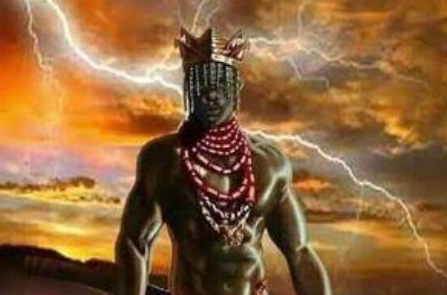
Amadioha is the Igbo God of Thunder and Justice (Alusi). This Divine Authority is the top judge in Odinani, the traditional Igbo religion. It upholds laws set by Ani, the Earth Goddess. The name, Amadioha, means “Free Man of the People.”
Judgment appears as a lightning strike that hits liars and those who break oaths. The White Ram and the color Red act as strong symbols of this deity.
Worship uses rituals and offerings guided by the Dibia Amadioha, the priest, during the Afor market day. Notable shrines, including the Ozuzu oracle, were once major judicial centers across Igboland.
READ ALSO: Alaafin Ajaka: The King Who Ruled Oyo Empire Twice
Who Is Amadioha, And Where Does His Worship Originate?
Amadioha is one of the most powerful gods (called an Alusi or Arusi) in the Igbo traditional religion (Odinani) of Southeastern Nigeria.
He rules Thunder and Lightning, and his highest duty is Divine Justice. Many people fear his force because he acts as a judge. Alusi punishes lies, broken oaths, and heavy crimes. A lightning strike is seen as his final verdict.
His name, Amadi-Oha, means “Free Man of the People.” In the Igbo spiritual world, Amadioha acts as the strong enforcer of moral law.
Chukwu is the Supreme God who made all creation. Amadioha works on earth as Chukwu’s active agent. Ani, the Earth Goddess, forms the moral laws that guide life. Amadioha uses thunder and lightning to make sure those laws stand firm.
The worship of Amadioha spreads across all Igboland, yet the deepest respect rises from the southern communities near the Imo River basin.
People once traveled long distances to reach sacred places such as the Ozuzu shrine. These visits helped settle disputes and restore peace.
What Are The Myths And Manifestations Of Amadioha?
Amadioha is the most visible Igbo god because his presence bursts through the powerful forces of nature.
Thunder roars like a warning. Lightning flashes like a sharp command. These signs help Igbo communities understand his justice and authority.
The Primary Symbols And Sacred Colors
When Amadioha appears in art or ritual, certain symbols reveal his holy power:
The White Ram:
This sacred animal is the top choice for offerings. A ram shows strength, bold leadership, and noble sacrifice. The white color shows clean justice and honest action.
The Color Red:
Red connects to his fierce energy, showing divine power, sudden wrath, and the burning force of lightning.
White Cloth:
Some shrines display a smooth white linen cloth as a sign of purity, reminding people of truth, order, and the clear path of moral duty.
Amadioha Heavenly Weapons And The Thunderstone
Many Igbo believe thunder speaks with its voice. Lightning strikes with his judgment.
A flash can leave a meteorite called Edi, or the thunderstone. This object is sacred. It serves as proof of Amadioha’s decision. He is also linked to Anyanwu, the sun god.
Partnership With Ani, The Earth Goddess
A major myth describes his union with Ani (or Ala), the mighty Earth Goddess, stating that their bond joins sky and earth to create universal balance.
Amadioha enforces the moral laws Ani sets.
READ ASLO: Ala (Ani): The Igbo Earth Goddess Of Morality, Fertility, And Law In Odinani
How Does Amadioha Serve As The Supreme Judge And Keeper Of Covenants?
Amadioha is the strongest judge in Igbo society, acting as the chief agent of Divine Justice for the Supreme Creator. He is the Keeper of Covenants and makes sure the moral laws set by the Earth Goddess, Ani, are obeyed.
The Igbo people see him as fair, but his judgment comes through thunder and lightning. It is final and can not be changed.
The Binding Ritual Of Iyi Amadioha (Oaths And Covenants)
The oath called Iyi Amadioha was the highest form of conflict resolution in traditional Igboland. It was used for serious cases with no human witnesses, such as poisoning, hidden theft, or land disputes.
Both sides would meet at his shrine. The priest, known as the Dibia Amadioha, led a ritual in which the person taking the oath might eat a piece of a consecrated White Ram or touch a sacred object called Ogwu.
This act was more than a promise to the community. It tied the person’s life to the truth. Anyone who broke the oath risked direct punishment from the sky.
Principles Of Divine Retribution And Consequences
Amadioha’s principle is summed up as “an eye for an eye.” His judgment appears as sudden death by lightning, leaving a dark mark on the person’s forehead.
Disasters like ruined crops or a home struck by a thunderbolt were also seen as signs of his action. A person struck down this way was treated as taboo or cursed. The body was left unburied and without mourning for a time, and the Dibia claimed the person’s property.
This denial of burial rites served as a powerful message that the Divine Authority had found the person guilty, strengthening the moral code for everyone else.
Before colonial rule brought Western-style courts, Amadioha’s shrines, especially the famous Kamalu Ozuzu Oracle in Ozuzu, were major judicial centers.
People traveled long distances to seek decisions from this oracle when local elders could not settle a dispute. The Dibia Amadioha served as the bridge between the people and the God of Justice. Their rulings, gained through divination, were final.
How Is Amadioha Traditionally Worshipped, And Where Are His Shrines Located?
Amadioha Worship is a serious, ceremonial event, not a daily routine. People seek this force when justice, a powerful blessing, or divine protection is needed.
The most sacred time for rituals and offerings is the Afor market day of the Igbo four-day week, which belongs to this deity.
Function Of The Priest (Dibia Amadioha)
The priest is central in all formal ceremonies and judgments. This figure is called the Dibia Amadioha (meaning “Doctor/Specialist of Amadioha”).
Dibia Amadioha serves as the official voice of the God of Thunder. Messages are received through divination, and petitions from the people are delivered with care.
The priesthood is confined to certain families (Umuamadi). Intense spiritual training prepares each new member to manage the deity’s power and guide the rituals. In earlier times, the Dibia held top authority over judicial processes, especially the risky oath-taking ceremonies.
Traditional Rituals And Acceptable Offerings
Worship follows steps and offerings that show purity and power.
The Highest Offering:
The White Ram is the strongest and most valued sacrifice. It is used for major problems or during the final oath (Iyi Amadioha).
Its white color symbolizes purity and truth, while the ram itself shows the deity’s power.
Common Offerings:
For daily prayers seeking fertility, good harvest, or steady protection, simple items like Kola Nut, palm wine, and Nzu (white chalk) are used.
White chalk is a common Igbo sign of welcome and innocence. Ceremonies focus on calling Amadioha to keep peace, unity, and justice within the community.
A shrine for Amadioha is known as Ebe Amadioha. These sacred spots appear in open clearings, near water, or under special trees touched by lightning.
The shrine usually holds a consecrated stone or object called the thunderstone (Edi). Decorations may include bamboo poles or white and red cloth, showing purity and power.
The Kamalu Ozuzu shrine in Ozuzu (now in Rivers State) is the most famous site. It once served as a major judicial center for large parts of Igboland.
READ ALSO: Aganju: The Orisha Of Volcanoes, And Wilderness
FAQs On Amadioha: The Igbo God Of Thunder, Justice, And The Keeper Of Covenants
Who Gave Birth To Amadioha?
As a supreme Alusi in Igbo religion, Amadioha was never “born.” This deity exists as a divine agent made by Chukwu, the Supreme God, to uphold justice and the laws set by the Earth Goddess, Ani.
What Does The Name Amadioha Mean?
The name Amadioha is read as “Amadi-Oha,” meaning “Free Person of the People” or “Collective Will of the People.”
How To Pray To Amadioha?
Prayer to Amadioha seeks justice, protection, or fertility. A Dibia Amadioha (priest) guides the rite, using offerings such as a White Ram, kola nut, or palm wine.
Where Is Amadioha Located In Nigeria?
Amadioha Worship appears across Igboland in Southeastern Nigeria. The best-known sacred site was the Kamalu Ozuzu oracle in Ozuzu, Rivers State.
Are Sango And Amadioha The Same?
No. Both act as mighty Gods of Thunder in Nigeria, but Shango comes from the Yoruba tradition and once lived as a human king. Amadioha belongs to the Igbo tradition and works only as a power of Divine Justice.